
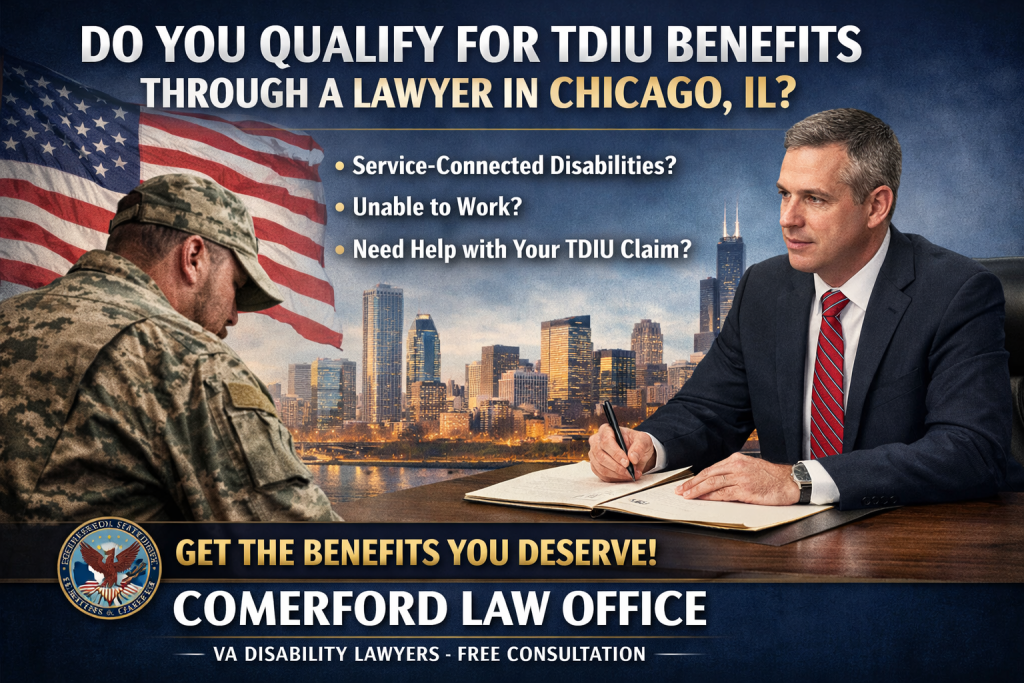
Many veterans in Illinois face challenges with their service-connected disabilities that make it impossible to hold down a steady job, and this can happen even when a veteran’s official VA disability rating is below 100%. Total Disability based on Individual Unemployability (TDIU) allows eligible veterans to receive compensation at the 100% disability rate, but it can be difficult to jump through all the hoops required to qualify. An experienced TDIU lawyer in Chicago, IL can help if you’re struggling and greatly improve your chances of qualifying.
Read the rest of this entry »Do You Qualify for TDIU Benefits?

TDIU, or Total Disability Individual Unemployability benefits, exist for the good of veterans who have suffered in the service of their country and cannot work because of their service-related disabilities. A TDIU lawyer with experience here in the Chicago, IL area can help you understand whether you’re eligible, gather the evidence you need to prove it, and fight for you if you’re initially denied.
Do You Qualify for TDIU Benefits?
To qualify for TDIU, you must be able to demonstrate that your service-related disability is what is keeping you from gainful employment. At a minimum, you must have a 60% disability rating for a single disability that’s connected to your service or a combined rating of at least 70%, with at least one of those disabilities rating 40% or more. Essentially, this means the condition must be pretty severe, and it must be very clearly connected to your service.
Both physical and mental disabilities can be taken into account when figuring TDIU eligibility. However, the VA will only consider disabilities that you can directly link to your service, and that’s going to take a lot of medical evidence, comprehensive documentation from your service, and a full employment history. In most cases, legal representation is the only way to get through the appeals process with any hope of success if you’re initially denied.
What Is “Substantial Gainful Employment?”
Your disability must prevent you from having “substantial gainful employment,” and this is defined as work that gives you enough income to exceed the federal poverty level each year. What that poverty level is changes a bit each year, but that’s the benchmark that will be used. Thus, even if you’re able to do some work, so long as you don’t go over the federal poverty level, you can still qualify for TDIU.
In 2025, the poverty level for a single person living in the 48 contiguous states is $15,650 in annual income. For a couple, it is $21,150, and for households with more people, the amount goes up by $5,500 for each person.
What Is a “Service Connection?”
The most important step in your application for TDIU benefits will be establishing a connection to your service. You’ll need to show strong evidence, which should include medical records documenting the onset of your disability and its progression and which clearly link it to your service. You’ll also need service records that show what duties you had and any incidents you were involved in that could have caused your condition or made it worse.
Talk With a TDIU Lawyer Today in Chicago, IL
While TDIU benefits are designed to protect veterans and offer some recompense for what they’ve suffered in the service of our country, the process of getting the benefits you are owed is often frustrating and difficult. If you have questions about your TDIU eligibility, need to bring a claim, or want to appeal a denial, reach out to us today at the Comerford Law Office in Chicago, IL. We also have offices in Jonesborough, TN and Highland, IN.
How to Claim VA Benefits for Anxiety Disorders

Military service is stressful and traumatic, and, fortunately, the VA now acknowledges that this stress and trauma have long-term effects on veterans. If you are a Chicago, IL veteran suffering from PTSD, generalized anxiety disorder (GAD), or any other similar issue, talk to a veterans’ benefits lawyer to get the help you need to claim the benefits you are owed.
How to Claim VA Benefits for Anxiety Disorders
Talk With a Chicago, IL Veterans’ Benefits Lawyer
The first step is to speak with a lawyer who has experience dealing with the VA. Even though the VA now acknowledges that veterans do suffer mental health disorders because of the trauma of their service, it’s still not easy to get the benefits you are owed. You’ll need to fill out lots of paperwork and attach all the proof the VA requires to get the proper rating. This can be difficult to do even under the best of circumstances, and if you’re suffering from panic disorder, social anxiety disorder, PTSD, or other issues, it can feel so overwhelming that you don’t want to even try.
By contacting a lawyer with experience, you get someone on your side taking care of the legalities and communication on your behalf.
Work With Your Lawyer to Determine If You Meet the Criteria
You’ll need to talk with someone who has experience and get evidence from your doctor to show that you meet three key criteria:
You Have a Current Diagnosis
First, you must have a current medical diagnosis. This must be in your medical records, either with a private medical service or in your service treatment records or VA records.
You Can Show a Service Connection…
The second criterion is to show that your anxiety was either caused by your military service or made worse by it. You’ll need to be able to show either a direct or a secondary connection. For a direct connection, you would need to show evidence of a specific event that caused or worsened your anxiety issue. This would be, for example, proof that you were in combat. Along with that, you’ll need to show a medical opinion that it is more likely than not that your time in the service either caused or worsened the issue.
A secondary connection is where you have developed an anxiety disorder as a result of some other service-related disability. For example, if you suffered injuries that now cause you chronic pain, and if this chronic pain has caused you to develop an anxiety disorder, this would be a secondary connection.
…Or, You Can Show Aggravation of a Pre-Existing Condition
You can also collect benefits if you can show that your anxiety was worsened by your service. You will have to be able to show that what you’re suffering is not just the natural progression of your disorder but has actually been made worse by your service.
Talk to us today at the Comerford Law Office in Chicago, IL for experienced help. We also serve veterans in Jonesborough, TN and Highland, IN.

If you’re realizing that your VA rating just doesn’t reflect what you’re really going through, a Chicago, IL lawyer with experience helping vets like you can assist you in getting the VA disability rating increase you need to truly reflect your situation.
What Steps Can You Take to Request a VA Disability Rating Increase in Illinois?
Talk to a Chicago, IL Lawyer
The first step is to talk with a lawyer who has experience in these matters. The claims process form alone is neither intuitive nor easy to fill out, and the regulations are difficult to get through. If you’re missing any documentation, you could end up with delays or even a denial.
Bringing an appeal is your right, but that’s not easy, either. An attorney will strengthen your case, fight for what you’re owed, manage your claim, and can even act as your power of attorney if your disability makes it especially difficult for you to handle things on your own. Your lawyer is going to push hard for the benefits you deserve, and together, you and your lawyer will do the following to get your rating increased:
Gather the Needed Evidence
The more medical documentation you have, the better. The VA is going to look for recent medical records showing the progress of your condition, detailed explanations from a doctor about exactly how your daily life is affected by your condition, and concrete proof that your symptoms have gotten worse, are appearing more often, or are lasting longer when they show up.
File a Claim
Once you have your evidence, you’ll need to file a claim to get a disability increase. This requires properly filling out VA Form 21-526EZ and attaching all your medical records and doctor statements. If you have evidence of how your disability is interfering with your ability to work, this will be especially helpful, and your lawyer can help you find the right evidence to show this.
File for Secondary Conditions
If you’re already suffering from a service-connected disability, it’s not uncommon for you to develop a secondary condition. Secondary conditions can be somewhat difficult to prove, since the VA often doesn’t want to work very hard to connect those dots, but if you are able to successfully claim for a secondary condition, it can increase your total monthly compensation for disability.
File an Appeal
If your first claim is denied, don’t give up. An experienced lawyer will be able to look over your claim and tell you whether it’s likely the denial is valid. And if it’s not, you can appeal for a higher-level review, where you don’t submit any new evidence but someone higher up takes a look at the case, or you can file a supplemental claim if you have new evidence that needs to be reviewed. You can also appeal to the Board of Veterans’ Appeals to have a Veterans’ Law Judge consider your case.
There are other options, and we can help. Don’t be discouraged: call us at the Comerford Law Office in Chicago, IL for help. We also have offices in Jonesborough, TN and Highland, IN.
How to Claim VA Benefits for Depression
If you live in Illinois and you have depression connected to your military service, you can apply for VA disability benefits. Depression can affect every part of your life, including your ability to work, maintain relationships, and carry out daily activities. To receive benefits, you must prove that your depression is related to your service and meets the VA’s disability rating criteria. This task is best suited to the expert skills of a VA benefits lawyer in Chicago, IL, who understands the law and honors the sacrifice and courage of veterans.
From a VA Benefits Lawyer in Chicago, IL: Claiming VA Benefits for Depression
Establishing a Service Connection
To claim VA benefits for depression, you need to prove that your condition is service-connected. This means that your depression must have either begun during your service, been caused by an event or injury in service, or been aggravated by your service. You must provide medical evidence, such as treatment records from your time in the military, post-service medical documentation, and opinions from qualified health care providers. If your depression is secondary to another service-connected condition, such as a physical injury or PTSD, we help you gather the evidence to establish that link.
Meeting the VA’s Medical Evidence Requirements
The VA bases its decisions on medical evidence. You need an official diagnosis of depression from a qualified professional, such as a psychiatrist or psychologist. The VA will also consider the severity and frequency of your symptoms, including issues like persistent sadness, loss of interest, difficulty concentrating, and impaired functioning. The more detailed and consistent your medical documentation is, the stronger your claim will be. We work with you to ensure that your medical records address the VA’s rating criteria so you receive an accurate disability rating.
Filing the Claim
You must file your claim either online, by mail, or in person. Along with the form, you should include all medical records, service records, and any statements from family, friends, or coworkers who can attest to how your depression affects you. These personal statements can support the medical evidence by showing the day-to-day impact of your condition. We make sure your application is complete and includes all the evidence the VA needs to evaluate your case.
If you are within 90-180 days of leaving the military, you can apply for a pre-discharge claim, which may significantly expedite the process of receiving compensation. This option is for veterans seeking to receive benefits as they begin the process of retiring from active duty.
Responding to VA Examinations and Requests
The VA will likely schedule a Compensation and Pension (C&P) examination to assess your depression. You must attend this exam and provide honest, detailed answers about your symptoms and their impact on your life. If the VA requests additional information, we help you respond promptly and completely so your claim does not face unnecessary delays.
Filing for VA benefits for depression in Illinois can be a complicated process, but you do not have to approach it alone. Our team focuses on building clear, well-supported claims that give you the best chance at securing the compensation you need to meet your healthcare needs after military service. Schedule a consultation with us today at Comerford Law Office in Jonesborough TN, Highland, IN, and Chicago, IL to increase your chances of receiving the benefits you deserve.
How does the VA Rate Sleep Apnea?

Sleep apnea is a disorder where breathing stops and starts during sleep. This condition can significantly impact a veteran’s quality of life, causing severe daytime fatigue, cardiovascular issues, and other health problems. Also, apnea is sometimes secondary to PTSD and coexists with other difficult conditions. Veterans often face unique risks and challenges that make them more susceptible to sleep apnea, such as exposure to environmental hazards during service or physical and emotional stress.
Understanding how the Department of Veterans Affairs rates sleep apnea is crucial for veterans seeking disability benefits. This blog provides an overview of the VA’s rating for sleep apnea, including relevant regulations, potential obstacles, and how Comerford Law Office can assist veterans in securing the benefits they deserve.
What is Sleep Apnea?
This condition is characterized by repeated interruptions in breathing during sleep. These interruptions can last from seconds to minutes and may occur thirty times or more per hour. Sleep apnea diagnosis usually happens with a sleep stud, and it may come with co-morbid conditions (similar disabilities, such as breathing problems or PTSD).
Types of sleep apnea include:
- Obstructive Sleep Apnea (OSA): Caused by a blockage of the airway.
- Central Sleep Apnea: This occurs when the brain does not signal muscles to breathe.
- Complex Sleep Apnea: A combination of both obstructive and central sleep apnea.
For veterans, exposure to dust, chemicals, and stressful environments during military service can increase the risk of developing this condition. Any such exposure should be clearly noted in the nexus letter so the VA can acknowledge it as military service-connected disability.
Also, sleep apnea with a continuous positive airway pressure (CPAP) machine and/or other treatments is still eligible for VA benefits because it indicates that the veteran is experiencing respiratory failure during sleep.
How Does the VA Rate Sleep Apnea?
The VA uses a schedule of ratings to determine the severity of a veteran’s sleep apnea and the corresponding disability compensation. The ratings are based on the veteran’s symptoms and the treatment required to manage them. Here’s how the VA rates sleep apnea:
- 0% Rating: Asymptomatic but with a documented sleep disorder.
- 30% Rating: Persistent daytime hypersomnolence (excessive daytime sleepiness).
- 50% Rating: Requires the use of a CPAP machine to maintain regular blood pressure.
- 100% Rating: Chronic respiratory failure with carbon dioxide retention (hypercapnia), cor pulmonale (right heart failure), and/or the need for a tracheostomy.
Relevant VA Regulations and Policies
The rating criteria for sleep apnea are outlined in the VA Schedule for Rating Disabilities, specifically under Diagnostic Code 6847. Veterans must provide medical evidence documenting their diagnosis and the extent of their symptoms.
Determining Severity and Rating
The VA evaluates the severity of sleep apnea based on medical examinations and evidence, including sleep studies. For example, if a veteran uses a CPAP machine due to sleep apnea, they may qualify for a 50% disability rating. More severe cases involving complications like chronic respiratory failure may warrant a 100% rating.
Potential Obstacles
Veterans may face several challenges when applying for benefits related to sleep apnea:
- Lack of Proper Documentation: Many claims are denied due to insufficient medical evidence.
- Service Connection: Demonstrating that sleep apnea is related to military service can be difficult without clear records.
- Appeals Process: If initially denied, navigating the appeals process can be complex and time-consuming.
How Comerford Law Office Can Help
Comerford Law Office helps veterans obtain the benefits they deserve. Attorney James R. Comerford, a member of the National Organization of Veterans Advocates (NOVA), has extensive experience in handling sleep apnea-related claims. The firm assists with:
- Gathering and submitting necessary medical documentation.
- Establishing a service connection for sleep apnea.
- Preparing an appeal if a claim is denied.
Get Help
If you or a loved one is struggling with sleep apnea and need assistance with a VA disability claim, contact Comerford Law Office today for a consultation. Our experienced team is here to help you every step of the way.

The short answer to this question is: yes. However, there is some nuance related to how the VA rates hearing loss and tinnitus.
Even if your hearing loss is enough to bother you, if you are assigned a 0% rating under the Rating Schedule for Hearing Impairments, you won’t be given any benefits. A 0% rating does not mean you’ve suffering no hearing loss: it just means that the VA believes it doesn’t affect your ability to work or perform your daily activities.
How the Rating Schedule for Hearing Impairments Works
There are two tests that the VA uses. The first is the Puretone Audiometry Test, which measures how well you can hear sounds, measured in decibels, at different frequencies. Each ear is calculated separately. The second test is the Speech Discrimination Test, which measures how well you can understand speech in a quiet environment. The VA combines these two tests to assign a disability rating.As stated above, the VA may give you a 0% rating even if you do have measurable hearing loss, if it believes that your hearing loss is not bad enough. Otherwise, you’ll be given a rating between 10% and 100% based on how severe the hearing impairment is. The VA is somewhat notorious for making it quite difficult to get a rating over 50%.
How the Rating for Tinnitus Works
Tinnitus is a very common issue for service veterans. Unfortunately, the VA has no nuance at all when it comes to tinnitus. If you suffer from tinnitus, no matter how mild or profound, and whether it affects one ear or both, you are simply given a 10% rating on the Rating Schedule for Hearing Impairment under Diagnostic Code 6260.
Establishing a Service Connection for Your Hearing Issues
In addition to qualifying through hearing tests, you must also prove that your hearing loss or tinnitus was caused, or at least aggravated, by your military service. The easiest way to do this is if you can prove a direct connection, such exposure to loud noises like gunfire or explosions.
In some cases, you will be claiming a secondary connection. This means that your military service did not directly cause the hearing loss itself but caused another condition which then caused the hearing loss or tinnitus. For example, if you suffered a concussion and developed tinnitus from it, this would be a secondary connection. Finally, there are some veterans who qualify for a presumptive connection. Presumptive means that the nature of their work while in the military was such that it can be presumed that it caused hearing loss. This is common for those who work with artillery or on aircraft, for instance.For help in strengthening your case for VA benefits, reach out to us now at the Comerford Law Office in Chicago, IL, where we’re dedicated to getting you the benefits you deserve.

If you served in the United States military, developed an asbestos-related condition, and served in a role that involved routine asbestos exposure, you may be entitled to receive presumptive VA benefits under the 2023 PACT Act. Veterans seeking presumptive benefits don’t always need to prove a direct causal link between service and their condition. An experienced veterans benefits attorney in Chicago, IL, can help you get the benefits you’ve earned.
Collect Your Medical Records
Your first step in establishing a claim to VA benefits related to asbestos exposure is collecting past and current medical records. These records will document any diagnoses, symptoms, and treatments for your asbestos exposure-related illness. Asbestos is associated with specific conditions like mesothelioma. With presumptive benefits, you don’t have to prove a direct link between service exposure and your condition.
You don’t have to prove that your condition is directly linked to service exposure to be eligible for presumptive benefits. Working with a Veterans’ Service Officer or a veterans benefits lawyer can help ensure your medical documentation is in order when the time comes to file your claim.
Gather Your Service Records
Your service documents will also be needed to file a claim for benefits, including your DD-214. The DD-214 documents critical details, such as where you were stationed, your job or specialty, and any asbestos-related activities that would put you at presumed risk for developing conditions linked to asbestos, like asbestosis or mesothelioma. Also, to claim VA benefits, you must have been honorably discharged, so discharge papers may also be helpful.
It can be helpful to create a summary of your lifetime exposure to asbestos to demonstrate that the majority of your exposure occurred during your military service. You’ll want to record when and where each instance of exposure occurred, if possible, and any details about the nature of the exposure could also support your claim. Your attorney or VSO can help you assemble a log of exposure throughout your service history.
Filing Your Claim
Once you, your VSO, and your attorney have collected the required documentation, you can submit your claim using VA Form 21-526EZ. The claim can be filed online or using traditional mail. If you already have a prior claim with the VA, you may be advised to file a Supplemental Claim.
After filing your claim, the VA will examine your records and determine whether you’ve experienced a condition based on asbestos exposure during your service term. If the VA confirms your diagnosis of a presumed asbestos-related condition, you will be assigned a disability rating between 1-100, expressed as a percentage. If your claim is denied for any reason, your VSO and attorney can file an appeal to secure any benefits you’re entitled to receive.
If you believe you have an asbestos-related condition linked to your service in any branch of the Armed Services, you may be entitled to presumptive benefits from the VA for your subsequent disability. To learn more about filing a claim for presumptive benefits related to asbestos exposure, contact the Commerford Law Office in Chicago, IL, today.

Hiring a VA disability lawyer can be an important step towards getting the benefits you’ve earned through military service. An experienced attorney can help you understand the VA claims process, increase your disability rating, and file an appeal if your claim is denied. Before hiring a lawyer to represent your VA case, there are some things you should know to ensure you get the representation you need and deserve.
Why Most VA Claims Are Initially Denied
As many as 70% of initial VA disability claims are denied, so veterans must pursue an extended and often difficult appeals process to get the benefits they believe they’ve earned. Claims may be denied for insufficient documentation, incorrect paperwork, or the lack of a demonstrated connection between military service and disability. Once a claim is denied, a VA disability attorney can offer the best way to appeal the denial and secure VA benefits.
How An Attorney Can Help You Gain Access to Benefits
While it’s possible to get benefits without an attorney, if your claim doesn’t generate the outcome you wanted, an attorney can help you correct that. A VA disability attorney can help gain approval for your claim or get a higher disability rating by demonstrating the connection between your service and your current condition, upgrading your discharge status to secure eligibility for benefits, or filing an appeal of an initial denial.
When to Hire a VA Disability Attorney
An attorney can help if your claim was denied due to:
- Lack of connection to your service
- Your discharge was characterized as anything but “honorable”
- You can’t access service or medical records
- Your disability rating is lower than it should be
What You Can Expect to Pay a VA Attorney
Veterans who are already battling through the economic impacts of disability are often concerned with the cost of hiring an attorney. Because of this, many VA attorneys take cases on a contingency basis, meaning there is no cost for representation unless your claim is successful and you win your case. An attorney may charge 20% to 33% of your retroactive benefits if you win, depending on the attorney and the details of your case.
What to Look For In a VA Disability Attorney
There are some qualities to look for when hiring a VA attorney for your case. You should find an attorney who specializes in VA disability law, and one who maintains a good reputation in the legal field and community at large. Communication is key, so find an attorney who values transparency and maintains an open-door policy with clients. Finally, look for a VA-accredited attorney who has extensive experience in litigating medical claims.
Though an initial denial of your VA disability claim may be frustrating, a VA attorney can help you navigate the appeals process and improve your chances of getting the benefits you’ve earned. To consult with an experienced VA disability attorney, contact us at Comerford Law Office in Chicago, IL, today.
The Hidden Daily Dangers of Military Life

Life in the military is physically demanding, mentally taxing, and often fraught with invisible hazards. While service members are trained to push through pain and discomfort, many face lifelong health problems as a result of their time in uniform. These injuries—chronic musculoskeletal disorders, mental health issues, and exposure to harmful substances—often go unreported and can complicate veterans’ attempts to seek the benefits they deserve. Understanding these risks is crucial for veterans navigating the benefits system today.
Chronic Physical Injuries
Injuries from daily military activities don’t always show up immediately. The physical toll of repeated high-impact exercises, heavy lifting, and the constant stress of combat duties leads to chronic musculoskeletal disorders (MSDs). Overuse injuries such as tendonitis, arthritis, and back problems are common but rarely reported in service records. These injuries are often seen as part of the job, and seeking medical help is sometimes discouraged. Military culture encourages self-reliance, but the long-term effects of these injuries can be debilitating.
The repetitive nature of tasks—whether it’s carrying heavy gear, jumping on and off vehicles, or engaging in tactical training—puts immense strain on the body. As many veterans know, this physical toll is not always recognized, and it can lead to severe, long-term conditions like osteoarthritis, which may not be immediately evident. It’s crucial that veterans seeking benefits bring documented medical evidence of these injuries, even if they were never formally diagnosed during their service.
Mental Health Struggles
Beyond the physical strain, the mental health challenges veterans face can also be tied to the daily hazards of military life. Exposure to combat, trauma, and the constant readiness required of service members can have lasting psychological effects. PTSD, anxiety, and depression are common, yet often, veterans do not seek help because of stigma or fear of career repercussions.
The culture of toughness in the military discourages individuals from showing signs of weakness. This can lead to long-term psychological damage that is not recorded in medical records, making it more difficult for veterans to receive appropriate care and compensation later on.
Toxic Exposure
Perhaps the most insidious hazard is exposure to toxic substances. Many veterans unknowingly encountered hazardous materials during their service. Jet fuel, asbestos, and other toxic chemicals are commonplace in military environments, from airfields to ship decks, and can lead to serious long-term health conditions. For example, prolonged exposure to Aqueous Film Forming Foam (AFFF), commonly used to suppress fires on military bases, has been linked to several health issues, including kidney cancer and developmental problems in children.
Veterans who served in certain regions or environments may also face risks from poor air quality, food and waterborne illnesses, and exposure to burn pits. These risks have been linked to chronic respiratory conditions such as asthma, COPD, and sleep apnea. The effects of such exposure may not surface until years after service, leaving many veterans without a clear connection between their health problems and their military experience.
Seeking Benefits
For veterans struggling with the hidden hazards of military service, the path to obtaining benefits can be complex. Many injuries and conditions are not reported or documented during service, making it harder to prove their connection to military life. To improve your chances of success, gather any available medical records, including those from civilian treatment providers, and be prepared to provide detailed information about your service-related activities.
While the military benefits process can be frustrating, it’s important to remember that you’re not alone. Many veterans have successfully navigated this system by bringing evidence of their service-related health problems. Don’t let the invisible injuries of military life be ignored. Your service may have taken a heavy toll on your body, but there are avenues to get the support you deserve.
Connect with us


- December 2025
- November 2025
- October 2025
- September 2025
- August 2025
- July 2025
- June 2025
- May 2025
- April 2025
- March 2025
- February 2025
- January 2025
- December 2024
- November 2024
- October 2024
- September 2024
- August 2024
- July 2024
- June 2024
- May 2024
- April 2024
- March 2024
- February 2024
- January 2024
- December 2023
- November 2023
- October 2023
- September 2023
- August 2023
- July 2023
- June 2023
- May 2023
- April 2023
- March 2023
- February 2023
- January 2023
- December 2022
- November 2022
- October 2022
- August 2022
- July 2022
- June 2022
- April 2022
- February 2022
- January 2022
- July 2020
- June 2019
- May 2019
- April 2019
- February 2019
- January 2019
- December 2018
- November 2018
- July 2018
- June 2018
- May 2018
- April 2018
- February 2018
- September 2017
- August 2017
- July 2017
- June 2017
- May 2017
- April 2017
- March 2017
- January 2017
- August 2016
Archives